

Forks, Knives, and Economic Clues
Let’s review one narrow economic indicator that provides a useful, though not standalone, measure of the overall economy’s health.
The US Census categorizes it as ‘food services and drinking places.’ That can best be described as restaurants and bars.
When the economy is riding high, most people feel optimistic and are more inclined to make discretionary purchases—non-essential items or services. This would include eating out.
As highlighted in Figure 1, eating out has far outpaced grocery purchases over the last four years. Notably, the upbeat pace has continued in recent months, suggesting an expanding economy.
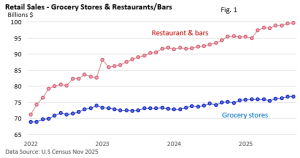
One drawback in Figure 1 is that it’s not adjusted for inflation. Plus, restaurant inflation has outpaced overall inflation, as measured by the US BLS’ Consumer Price Index. Gains may simply be due to rising menu prices.
Figure 2 attempts to adjust for inflation by comparing the annual change in sales at restaurants with the annual change in the CPI for eating out. Given that adjustment, sales are outpacing inflation in all but two months.
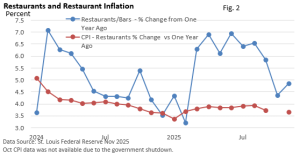
This is not a sign of economic weakness, despite sluggish hiring and consumer confidence surveys that reflect a gloomy mood. If economic anxiety were a big concern, we’d probably see weakness in this indicator, like fewer trips out or people switching to cheaper restaurants.
That’s not the case.
As with any anecdotal measures of economic activity, it must be paired with broader economic reports. Today, most economic data is signaling an expanding economy.