

A Q2 to Remember
“S&P 500 Index, Nasdaq Log Their Best Quarter since 2020,” read a story in the Wall Street Journal. “Dow Heads for Best First Half in 5 Years,” according to CNBC. And it wasn’t simply the biggest U.S. firms, which are represented in the Dow, the Nasdaq, and the S&P 500 Index.
CNBC reported, “Small-Cap Stocks Enjoy Their Best First Half in 35 years.” Here’s one more from Bloomberg News: “Chip (semiconductors) Stocks Best Quarter Ever is Ending with Some Wild Swings.”
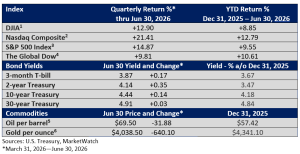
Well-diversified investors benefited from bullish sentiment, but questions naturally arise about why broad-based market indexes had such a strong quarter.
1. For starters, timing played a role. Following a modest decline in March tied to the war with Iran, major market indexes bottomed one day before the first quarter ended and rallied sharply.
Simply put, nearly all of the advance being measured occurred since the market’s most recent bottom, along with a reversal of fears tied to the conflict with Iran.
2. Next, fueled by the AI boom and technology giants, corporate America continued to deliver exceptional profit growth, reinforcing confidence in both the economy and stock valuations.
According to LSEG, S&P 500 companies reported earnings growth of nearly 30% for the quarter that ended in March. It was the strongest increase since 2021 and roughly double what analysts had expected at the start of the reporting season.
To be sure, earnings estimates are often conservative, and most companies routinely clear a low bar. But beating expectations by that magnitude was extraordinary. In addition, analysts have been raising profit forecasts for the remainder of the year.
3. Despite the jump in gasoline prices, economic growth and consumer spending were stronger than many investors had feared, reducing recession concerns.
There were concerns that higher gasoline prices would force tough choices. Filling up the gas tank is a necessity, and dollars earmarked for other purchases might fall by the wayside.
That didn’t happen.
Economic theory suggests that an unexpected surge (or drop) in the price of a key staple won’t affect other items, at least initially, because there is a sense that a price hike (as was the case) will be temporary.
So, consumers simply add to debt or dig into savings until prices subside.
While gasoline prices remain elevated, they have retreated from earlier highs.
4. Interest rates crept higher but nothing dramatic, as strong profits offset rate worries. That said, Fed Chief Jay Powell’s four-year term as Fed chairman ended in May. He served two terms—8 years. Kevin Warsh has taken over as Fed chair.
He concluded his first meeting last month. And this is where it gets interesting.
A new Fed chief must convince the rest of his troops—11 other voting Fed officials (12 determine rates and policy)—to carry out his wishes or, at a minimum, marshal a consensus.
As an economist and former Fed official, Warsh has historically been hawkish, meaning he is more concerned about inflation and willing to raise interest rates to curb it, even if higher rates might slow economic growth.
At his first meeting, he left little room for ambiguity, vowing that the Fed “will deliver price stability.”
That prompted investors to price in the possibility of at least one rate hike later this year. Perhaps it’s just tough talk, but a rate hike or hikes this year shouldn’t be ruled out.
What does this mean? A resilient economy and robust profit growth have been powerful tailwinds for equities. However, higher interest rates could create volatility.
Celebrating America
This Fourth of July carries special meaning this year. As America celebrates its 250th birthday, we have an opportunity to reflect on one of the most extraordinary stories in human history.
Two and a half centuries ago, a group of visionaries signed the Declaration of Independence and launched an experiment unlike any the world had seen.
The founding fathers believed that people should govern themselves, that individual liberty mattered, and that every person possessed certain unalienable rights.
Those ideas have inspired generations of Americans and countless others around the globe.
America’s accomplishments are vast. They include the expansion of democracy, freedom, and equality around the world, a dynamic and innovative economy, and ingenuity that has put men on the moon and sent spacecraft to the farthest reaches of the solar system.
But the story of America is not just about accomplishments. It is also about the people who have worked to make the country live up to its founding ideals.
Each generation has contributed to the ongoing pursuit of a more perfect union, expanding opportunity, and strengthening the principles of freedom, liberty, and equality.
As fireworks light the sky, we celebrate not only America’s past but also its future. The challenges are real, but so are the opportunities. The same spirit of resilience, optimism, and determination that carried the nation through its first 250 years remains alive today.