

Chips in Flux
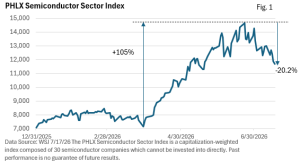
Since the most recent market low at the end of March, semiconductors (microchips, commonly called chip stocks) have been a very popular trade. In less than three months, the PHLX Semiconductor Index has more than doubled—see Figure 1.
Investors are expecting a staggering rise in second-quarter earnings for the semiconductor sector, with profits expected to rise by 131%, according to MarketWatch.
But why have chip stocks entered a bear market—a drop of at least 20% from peak to trough? The index is down 20.2% from its June 22 peak. It remains substantially higher than the late-March low and the end of last year.
For starters, chips became a crowded trade, i.e., a large number of investors holding the same position. With investors heavily concentrated on the same side of the market, liquidity risks build beneath the surface, creating the potential for a rapid and disorderly unwind if the trade begins to reverse.
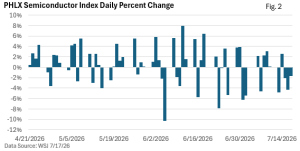
Figure 2 illustrates the high level of volatility since late April, both to the upside and downside.
What’s going on in recent months? Semiconductor stocks took off as massive demand from the buildout of AI data centers fueled huge purchases of memory chips. Infrastructure needs are enormous, including demand for memory chips from these chip makers.
But investors are constantly reassessing how sustainable the AI boom really is. Besides, the production cycle for chip makers has historically been feast-or-famine.
In addition, have valuations in this sector already risen to a level that prices in stellar growth? Of course, that’s a difficult question to answer, but it may be playing a role in recent volatility.
LPL Research recently opined, “The most dangerous investment mistakes often begin with an inability to imagine outcomes that differ from what the market expects.
LPL added, “That does not mean investors should reflexively bet against strong trends, because momentum is real and great businesses can stay great for a long time, but when an investment thesis depends on outcomes that are inherently unknowable, imagination becomes a risk-management tool.”
How strong has demand been? “The computing power of the total stock of AI chips has grown at 3.4 times per year, doubling every 7 months since 2022, based on revenue data, other financial disclosures, and analyst reports,” according to Epoch AI.
The recent pullback in semiconductor stocks may simply represent a healthy correction, helping to flush out excess optimism and speculative froth.
For now, AI remains in a powerful cycle as hyperscalers try to catch up and anticipate future demand for AI.