

Reading Signals from the Bond Market
Investors can choose fixed-income securities across a wide range of maturities—from bills, notes, and bonds that mature in a few days to those that mature in 30 years.
Treasuries are liquid—generally easy to sell—so there’s no rule that one must hold a 30-year bond to maturity. That said, most investors avoid such bonds and focus on T-bills—up to one year—or notes and bonds ranging from 2 to 10 years.
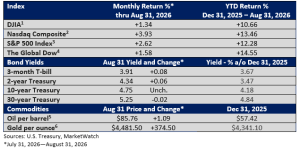
If yields decline by a similar amount across the Treasury yield curve, a 30-year bond will appreciate in value much more than a 5-year or 10-year bond. Conversely, the 30-year bond’s price will fall much more if yields rise (yields and price move in opposite directions).
In other words, capturing a slightly higher yield comes with added risk if rates move against you.
So, who buys ultra-long-term bonds?
Institutions such as pension funds, insurance companies, and endowments typically gravitate to the 30-year Treasury bond because they often have long-term liabilities extending decades into the future. Let’s just say it’s usually the big boys and big girls that tap into this market.
The next question is, “Why would the average investor care about what’s happening to the 30-year when they aren’t involved in this space?” The short answer: what happens in the bond market can positively or negatively affect stocks.
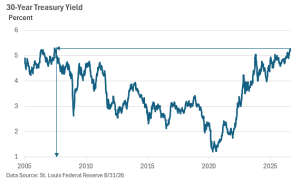
The graphic below illustrates that the 30-year yield hit its highest level since 2007. That was just before the financial crisis. It had been in a long-term downward trend since 1980.
Investors have also watched the 10-year yield back up, but it remains below its recent October 2023 high of 4.98%.
Although economic growth remains positive, hiring has been soft, which would ordinarily help ease upward pressure on bond yields.
Instead, bond investors appear to be focusing on a different combination of factors.
1. The persistent federal deficit and the need to issue new bonds to finance the deficit
2. Concerns about stubbornly elevated inflation
3. Investors insisting on a larger premium to lock up funds for long periods
4. Recent questions about Fed credibility regarding its fight against inflation (somewhat allayed by a late-August speech by Fed Chief Kevin Warsh)
5. Rising corporate debt issuance to fund the AI buildout, though some view this as a secondary factor.
Treasury flexes its muscles
Late last month, US Treasury Secretary Bessent announced an expansion of the Treasury’s buyback program for longer-dated debt.
The Treasury plans to repurchase more outstanding 10- to 30-year securities, which, in theory, increases demand for those bonds and puts downward pressure on their yields.
CNBC reported that Bessent could tap up to a $1 trillion Treasury General Account to fund bond buybacks. Though unconfirmed, that would provide considerable firepower to stabilize and possibly bring yields down.
Despite questions about how effective the program might be over a longer period as well as finite resources from the Treasury Department, Bloomberg News reported near the end of August that “key market metrics and positioning show that it’s having an impact.”
But let’s take a much longer-term perspective. Historically, a 5% Treasury yield isn’t that unusual. In fact, it is closer to the long-term historical average than the exceptionally low yields investors became accustomed to after the 2008 financial crisis.
So far, investors have largely shrugged off the rise in yields, as booming corporate profits continue to provide a powerful tailwind for equities.
As we enter the historically volatile month of September, higher yields have yet to derail the market’s advance but may have simply tempered its advance.