

Yields Jump: Reading the Bond Market’s Signals
What dominates the headlines today may be forgotten tomorrow, and what could move stocks tomorrow may barely register with investors today. But for now, the market’s focus is on interest rates. Figure 1 illustrates the recent rise in yields, with February 27 marking the 2026 low for the benchmark 10-year Treasury yield.
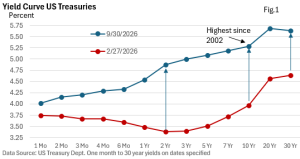
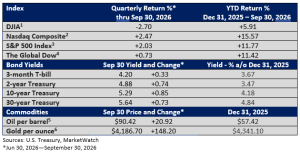
Figure 1 highlights the rise in Treasury yields across the yield curve, while the table above pinpoints the rise in yields for various Treasury bonds in the third quarter. Notably, the rise in the 10-year was the 10th-largest quarterly increase since 1962 (St. Louis Federal Reserve).
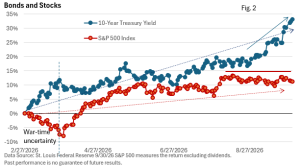
Although rising bond yields have created stronger headwinds for equities, stocks have been remarkably resilient and ended the quarter near all-time highs.
Figure 2 illustrates that resilience, comparing the percentage rise in yields with the percentage change in the S&P 500 Index.
Put another way, both stock prices and bond yields are higher, which defies conventional wisdom that rising interest rates should depress stock prices.
Instead, strong corporate profits have been a powerful tailwind for stocks.
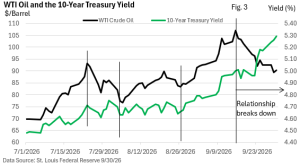
Let’s take it a step further. Figure 3 reflects the impact of oil on bond yields since the beginning of the third quarter.
Relationships like these eventually break down, and that may have started near the end of Q3, but for much of the quarter, oil prices heavily influenced the direction of bond yields, as measured by the 10-year Treasury yield.
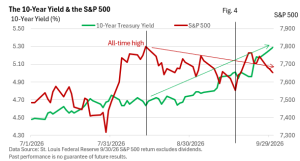
Finally, Figure 4 highlights the more nuanced relationship between bond yields and stocks. Although both yields and the S&P 500 rose during the third quarter, rising yields weighed on equity prices from mid-August to mid-September.
Why have yields risen to multi-decade highs?
1. First of all, the Federal Reserve raised the fed funds rate in September, and investors believe more may be in the pipeline, according to a gauge from the CME Group. But it’s not simply the Fed. The bond yield equation is more complicated than that.
2. The economy appears to be gaining steam—the US Bureau of Economic Analysis just revised Q1 and Q2 GDP higher—and rising demand for goods and services typically raises the cost of money, i.e., the rate to borrow.
3. While it may be playing a secondary role, the AI buildout is fueling hundreds of billions of dollars in new business investment, some of which is being financed through the bond market. Greater supply could be boosting rates in order to attract the needed capital.
4. Meanwhile, the persistent federal deficit has led to a steady stream of new Treasury debt, which may be putting upward pressure on yields.
5. Lastly, there are lingering worries about inflation.
How might stocks react?
The table below provides a historical review of market response to Fed rate hikes.
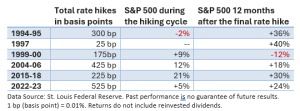
Rising bond yields tied to 1994’s aggressive 12-month rate hike campaign modestly pressured equities. Alan Greenspan’s Fed was preemptively striking out against a possible rise in inflation.
In 2022, the Fed was reacting to rising inflation. It lifted rates at the fastest pace in 40 years. A bear market ensued, but stocks quickly recovered as the economy avoided a recession.
In contrast, rate hikes in 2004-06 (25 basis points per meeting) and 2015-18 were less aggressive, and rising corporate profits supported equities.
In every case, the S&P 500 was higher 12 months after the final rate hike. The lone exception came after the 1999-2000 cycle, when the economy fell into recession and the dot-com bubble burst.
Rising bond yields may continue to create volatility in the months ahead, but history suggests that higher rates do not automatically derail bull markets. Much may depend on why rates are rising and the pace of rate hikes. For now, investors appear focused on the forces that can accompany rising yields: a growing economy and healthy corporate profits.