

Inflation Heats Up as Gasoline Prices Surge
Led by a 10.9% rise in energy, including a 21% rise in gasoline, the US Bureau of Labor Statistics reported that the Consumer Price Index (CPI) rose 0.9% in March, the highest in almost four years. On an annual basis, prices rose 3.3%.
If food, which was unchanged, and energy are excluded, the core CPI rose 0.2%. It was up 2.6% from one year ago. Economists closely watch this so-called core measure in an effort to better capture inflation’s underlying trend.
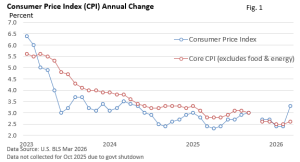
It comes as no surprise that the CPI surged last month amid the sharp rise in gasoline prices.
Otherwise, outside of energy, the CPI was less discouraging.
Let’s review Figure 2, which breaks the CPI into two key categories: services and consumer goods.
As supply chains normalized in the wake of the pandemic, inflation in consumer goods slowed sharply and briefly slipped into deflationary territory. Services inflation proved to be more persistent, but it has since eased back toward pre-pandemic levels.
More recently, however, inflation in consumer goods has re‑accelerated.
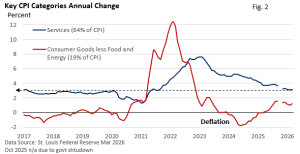
Trade‑related cost pressures that businesses initially absorbed appear increasingly to be passed on to consumers. If the recent pickup in consumer goods prices is driven largely by tariffs, however, the Fed would likely judge it to be temporary and look through the increase.
Given the CPI’s methodology, inflation may be slightly lower right now due to the government shutdown. That should work its way out of the CPI by April or May. There have also been signs that wholesale and import prices have also ticked up recently.
That pickup may prove to be temporary, much like past trade-related cost pressures, while generally tame services inflation could allow the Fed to look past the oil-price shock.
If not, the Fed could find itself caught between two goals: supporting a softening labor market or responding to renewed inflationary pressures.