

Markets Rotate: What’s Driving the Shift; Plus, the Dow Crosses a Milestone
After leading markets for much of the past two years, AI, tech stocks, and software specifically, are losing leadership in early 2026, as investors rotate capital toward other sectors, including energy, industrials, and defensive sectors.
This shift is not the result of a single bad earnings season or a collapse in AI demand. In fact, the opposite is true based on a strong start to Q4 earnings season.
Instead, it has been a repricing of risk and valuations. It’s a 2026 reset, triggered partly by AI itself.
At the center of the recent move is the concern that rapid advances in AI are disrupting traditional software economics faster than expected.
Recent releases from AI developers, particularly Anthropic’s plug‑ins and Claude Opus 4.6, have raised concerns that certain software‑as‑a‑service models may face pricing pressure or declining demand, as autonomous “agent” tools take on legal, analytical, and administrative work.
It’s not new. Concerns have simmered for months, especially worries within the software sector.
Yet, while recent earnings reports have been strong, shorter-term investors have focused on various metrics in the reports or remarks from post-earnings conference calls with company executives.
Meanwhile, exceptionally strong demand for memory chips used in AI data centers may constrain growth for other technology firms, as shortages and delays in key components make it harder to scale production and meet demand.
Moreover, some investors are starting to question the staggering capital expenditures of hyperscalers, which are companies that operate and build massive, globally distributed data‑center infrastructure.
Why are major tech firms set to pour hundreds of billions of dollars into data centers this year? Demand for AI is strong, and investments are being made to meet growth today and tomorrow.
Nvidia’s (NVDA $184) CEO Jensen Huang told CNBC on Friday that surging capital expenditures for AI infrastructure are justified, appropriate, and sustainable. He said the AI buildout is being driven by “sky-high” demand for computing power.
Yet, there are anxieties in some quarters that excessive spending could create too much capacity, making it harder to monetize those expenditures and potentially dampening future profits.
With interest rates remaining higher for longer, investors are less willing to pay premium prices for long‑term growth. Instead, recent money has flowed into other industries that may benefit from tighter supply, infrastructure investment, and geopolitical demand.
As a result, sectors that had been ignored have recently benefited.
While AI remains a powerful long‑term theme, the market is signaling that not all tech and software companies will be winners, highlighting the importance of diversification.
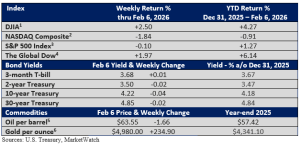
Nonetheless, to put the recent volatility in context, the S&P 500 is down just 2.58% from its January 27 peak to Thursday’s most recent low (MarketWatch data). And on Friday, the Dow Jones Industrials surpassed and closed above 50,000 for the first time in its history.