

Dramatic Recovery
The S&P 500 Index shed 9.1% from its late January all-time high to its March 30th low, just shy of an official 10% correction. The index of 500 large publicly traded companies lost a more modest 7.8% of its value when gauged from the start of the war to its most recent low.
The nearly 8% selloff is less than half the S&P 500’s decline in April 2025, when the president announced the so-called Liberation Day tariffs.
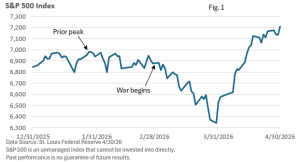
Given the weighty events in the Middle East and the potential disruptions to the US and global economy, stocks have proved to be exceedingly resilient.
While risks remain, the rally that began at the March 30th low is dramatic and has been compared to the rally off the 2020 Covid lows and to the early stages of the 18-year bull market that began in August 1982.
While both exceeded the current rebound from the near-term bottom, the S&P 500 Index is up an impressive 13.64% through the end of April.
To be clear, this is not a call for a repeat of 1982 and the 18-year bull market that followed. That rally began as inflation and interest rates were entering a prolonged decline, the economy was climbing out of a deep recession, and stock valuations were much lower than today.
But it is a cautionary tale that:
1. Accurately identifying any market bottom in advance is extraordinarily difficult.
2. Rallies that follow may be swift and powerful.
3. Geopolitical uncertainty has rarely had a lasting impact on stocks. Interest rates, Federal Reserve policy, inflation, economic growth, and profit growth have historically been the biggest determining factors of market sentiment.
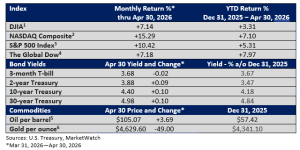
Finally, while the S&P 500 Index and the tech-heavy Nasdaq Composite set new highs in April, the Dow remains slightly below its all-time high. Both the Dow and the Nasdaq entered correction territory, notching declines of just over 10%.
Oil’s waning influence
Markets are no longer moving in lockstep with oil.
Early in the conflict, higher oil prices led to lower stock prices. Conversely, falling oil prices fueled short-term rallies in March. The inverse correlation was extremely high. More recently, however, that link has weakened.
By month’s end, the price of oil remained elevated. However, the S&P 500 finished April at a fresh record.
Why haven’t events continued to pressure stocks?
1. In some respects, investors are gradually growing accustomed to the war, i.e., investors have shifted from shock to adaptation. Besides, a ceasefire has alleviated some uncertainty.
2. Markets price the future and not the present, and investors are still pricing in a relatively quick outcome.
3. In the medium and longer term, stocks are driven by economic fundamentals, including interest rates, Federal Reserve policy, economic growth, and corporate profits. And profits have been strong.
4. Oil matters, but only up to a point. The US is the world’s largest producer of oil, which helps buffer the domestic economy from global energy shocks. While higher oil prices still affect consumers, the economic disruption is likely to be more limited at home than in heavily import-dependent regions such as Europe and Asia.
In plain English, stocks have surged because investors believe the war won’t significantly damage the broader US economy.
But risks never completely disappear. What could change sentiment? Markets could react negatively again if:
• Oil spikes much higher (a supply disruption).
• The war escalates significantly.
• Inflation reaccelerates.
• The Federal Reserve hikes rates unexpectedly.
Final thoughts
Although investors continue to monitor developments in the Middle East, a temporary ceasefire has helped refocus attention on economic fundamentals—solid growth and strong earnings—allowing stocks to rebound from March’s selloff and resume their upward momentum.
As always, please reach out if you have any questions or would like to discuss other topics.