

The Fed Hikes Rates: What Investors Should Know
In his opening remarks in a speech last month at the Federal Reserve Bank of Kansas City’s Economic Symposium, Fed Chief Kevin Warsh said, “(Event) planners have some recreation options lined up for later today. And I’d advise you to be very careful with your choices. As I learned years ago, you can take two different kinds of hikes on the trails around Jackson Hole (Wyoming).
“I can sum up my hikes with former Vice Chairman Don Kohn in two words: I survived. These steely marathon death marches revealed a side of Don I wasn’t ready for.
“There’s another kind of hike—one I associate with Chairman Ben Bernanke, my old colleague. With Ben, it’s a much more leisurely pace, an easy stroll along the wandering trails at the Rockefeller Preserve.”
Warsh isn’t fond of offering interest rate forecasts (often called guidance). Moreover, he chooses his words carefully. While his comments about various ‘hikes’ elicited laughter, his use of that specific word ‘hike’ (as in a rate hike) wasn’t lost on analysts.
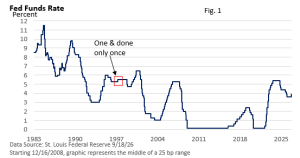
Last week, the Federal Reserve voted to raise its key interest rate, the fed funds rate, by a quarter percentage point to 3.75–4.0%. It’s the first increase in three years.
So, in keeping with his Jackson Hole remarks, was Warsh hinting at a more aggressive series of rate hikes—steely marathon death marches—that might bring inflation under control more quickly? Or was he suggesting that a gentler pace is on the horizon, i.e., the Rockefeller Preserve?
He didn’t offer an outlook last week, but the Fed is clearly taking a more hawkish tone, with Warsh noting, “The plain fact is that inflation is too high and has been for too long.”
As illustrated in Figure 1, the Fed has been “one and done” only once in the last 40 years. The Fed’s economic projections, released quarterly, suggest one more hike by December.
Beyond that, the press conference offered little additional clarity. Lasting just 29 minutes, he painted an upbeat picture of the economy, but otherwise, his remarks were sometimes less than transparent, and he declined to take any follow-up questions from reporters.
That stood in contrast to his June press conference and the practice commonly followed by former Fed Chair Powell, who routinely allowed reporters to seek clarification with follow-up questions.
Investor reaction to rate hikes—historical review
What has happened to stocks when the Fed begins hiking rates? The table below illustrates the return of the S&P 500 Index during a rate-hike cycle and one year after the rate-hike cycle ends.
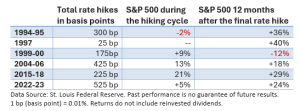
The aggressive hiking cycle of 1994-95 hampered equities. While stocks rose during the 2022-23 rate-hike cycle, the S&P 500 briefly entered a bear market in 2022—down 25% at one point—amid the sharpest series of rate hikes since 1980. Otherwise, rate hikes aren’t necessarily negative.
LPL Research noted that since 1994, stocks have generally struggled in the first several months after the first rate hike.
But LPL was quick to add that early headwinds typically did not lead to lasting losses. Every cycle has its own peculiarities (and 2026 is no exception), but in most tightening cycles, stocks ultimately generated gains over the following 12 months as investors adjusted to higher borrowing costs and refocused on the underlying strength of economic growth and corporate earnings.
Much may ultimately depend on how economic growth plays out.